
Pedestrian accidents are among the most devastating traffic collisions in New Jersey because people on foot have no protection against vehicles weighing thousands of pounds. Busy suburban roadways, commercial corridors, transit stops, and residential intersections across North, Central, and South Jersey regularly see pedestrians struck by drivers who are distracted, speeding, or failing to yield.
MetroLaw.com represents injured pedestrians throughout New Jersey, assisting victims in obtaining compensation for medical expenses, lost income, and long-term recovery needs. Whether the accident occurred near a transit hub, shopping center, residential neighborhood, or major roadway, injured pedestrians have legal rights under New Jersey law.
This guide explains how pedestrian crashes happen, what compensation may be available, and what steps injured victims should take to protect their claims after an accident.
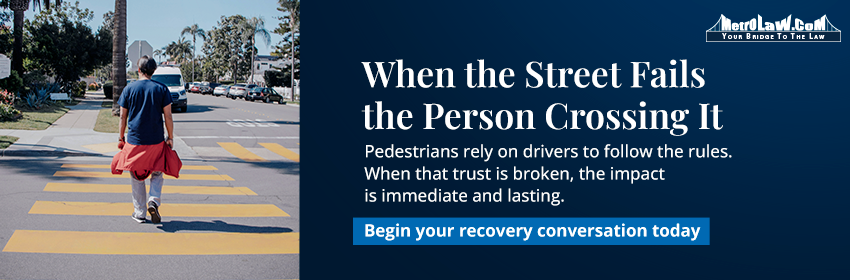
Pedestrian accidents commonly happen on suburban arterial roads, particularly near shopping centers, transit stops, and commercial areas throughout New Jersey. These locations often feature high vehicle traffic combined with frequent pedestrian crossings, leading to hazardous conditions. This danger is heightened when drivers speed, become distracted, or fail to yield to pedestrians.
Many serious pedestrian crashes occur on multi-lane roads designed primarily for vehicle flow rather than safe pedestrian movement. These roads are common throughout North, Central, and South Jersey and often connect residential areas with retail and commercial zones.
Some risk factors are:
Pedestrians often must cross several lanes while vehicles continue moving at speed, increasing both collision risk and injury severity.
Parking lots and commercial driveways are significant sources of pedestrian injuries. Drivers often concentrate on finding parking spaces or oncoming traffic, overlooking pedestrians who are walking between stores and parked vehicles.
Some of the dangers are:
These crashes often happen at low speeds but can still cause serious injuries, particularly to children and older pedestrians.
Bus stops and train stations frequently place pedestrians near busy roads without safe crossing infrastructure. Riders often cross mid-block or hurry across traffic to catch transportation.
High-risk situations are:
These locations combine heavy pedestrian movement with distracted or impatient drivers.
Although vehicle speeds are typically lower, residential streets still see pedestrian injuries, especially involving children, joggers, and dog walkers. Contributing factors are:
Even lower-speed impacts can cause serious harm when pedestrians are struck directly.
During peak travel seasons, shore towns and tourism areas experience increased pedestrian traffic combined with congested driving conditions. Seasonal risk factors are:
As pedestrian volume rises, collision risks increase, particularly during evenings and weekends.
Many serious pedestrian crashes occur in suburban commercial corridors where roads are wide and traffic moves quickly. Urban areas see more pedestrian activity, but slower vehicle speeds can sometimes reduce injury severity. Both environments present risks when drivers fail to yield.
Drivers often fail to notice pedestrians due to distraction, poor visibility, blind spots, or rushing through intersections. Nighttime driving, bad weather, and congested traffic further reduce reaction time, leading to many pedestrian crashes across New Jersey roadways.
Cell phone use remains one of the leading contributors to pedestrian crashes. Drivers may be:
Even a few seconds of distraction can prevent drivers from noticing pedestrians in crosswalks or along roadways.
Many pedestrian accidents occur when drivers turn through crosswalks while watching traffic instead of pedestrians. Right turns on red and left-turn traffic conflicts are common collision points. Drivers focused on finding gaps in traffic often overlook pedestrians already in the crosswalk.
Rain, snow, and darkness reduce visibility, making pedestrians harder to see, especially when crossings lack lighting. Wet pavement, glare from headlights, and reduced contrast all contribute to visibility problems that increase crash risk.
Yes, pedestrian accidents are generally worse at night. This is largely due to reduced visibility, which hampers drivers' ability to see pedestrians clearly. Such limitations can delay driver reaction times, leading to higher crash severity and an increased risk of injury for pedestrians. Additionally, factors like impaired driving and decreased attention during nighttime hours can further exacerbate the danger, making it crucial for both drivers and pedestrians to exercise extra caution after dark.

Certain groups, including children, older adults, transit riders, and people walking along high-speed suburban roads, face greater risks in pedestrian crashes. Differences in mobility, visibility, reaction time, and walking environments make these pedestrians more vulnerable when drivers fail to slow down or yield across New Jersey roadways.
Children are especially vulnerable because they often struggle to judge vehicle speed and distance accurately. Their smaller size also makes them harder for drivers to see, particularly when vehicles are parked along streets.
Some risk situations are:
School arrival and dismissal times often increase pedestrian and vehicle congestion, creating additional risks.
Older adults are at greater risk because they may walk at a slower pace and have a reduced ability to evade approaching vehicles quickly. When accidents occur, injuries are often more severe, and the recovery process typically takes longer.
Some risk factors for seniors are:
Wide suburban roads with short crossing signals can create dangerous conditions for older pedestrians.
People using buses or trains frequently must cross busy roads to reach stops or stations, sometimes outside marked crosswalks. Timing pressure and traffic congestion increase risks.
Some danger points are:
Drivers often focus on traffic flow and fail to anticipate pedestrians near transit stops.
People walking home from evening or overnight jobs often travel during hours with reduced visibility and lower traffic enforcement presence. Additional risks are:
These conditions increase the likelihood that drivers will overlook pedestrians.
Many New Jersey suburban areas have crossroads centers, restaurants, and offices along wide roads not designed for safe pedestrian travel. Pedestrians in these areas often:
Drivers may not expect pedestrian traffic in these vehicle-focused zones.
Yes, older pedestrians often experience more severe injuries and longer recovery periods due to physical vulnerability and preexisting health factors. Even lower-speed impacts can cause significant harm compared to younger people.
Injured pedestrians may recover compensation for medical expenses, lost wages, rehabilitation costs, and pain and suffering. Severe cases may include future medical treatment and long-term disability damages to address ongoing financial and personal impacts.
Potential claims encompass:
Compensation may also address:
Several factors influence the value of a pedestrian accident claim:

Insurance companies often attempt to limit payouts in pedestrian accident claims by disputing fault or minimizing injuries. Adjusters may argue that the pedestrian contributed to the crash or that medical treatment was excessive. To protect their rights and avoid unfair settlements, injured pedestrians benefit from knowing these tactics.
One of the most common defense strategies is shifting responsibility onto the injured pedestrian. Even when drivers clearly fail to yield, insurers may argue the pedestrian acted unsafely.
Common arguments include claims that:
Under New Jersey comparative negligence law, insurers try to assign partial fault to reduce the amount they must pay.
Insurance companies may also question the severity of injuries, particularly when symptoms develop after the accident rather than immediately. Adjusters sometimes argue:
This is why consistent medical treatment and documentation are important when pursuing compensation.
Another tactic involves claiming that medical care is not connected to the accident. Insurers may say:
Medical records and physician opinions help establish a clear connection between the crash and injuries.
Insurance companies sometimes offer early settlements before victims fully understand their injuries or financial losses. Early offers may:
Once a settlement is accepted, additional compensation is generally unavailable even if injuries worsen.
Shortly after accidents, insurers may request recorded statements that later become tools to dispute claims. Some problems are:
Careful communication helps prevent statements from being misinterpreted later.
When considering whether to accept the first settlement offer, it’s important to remember that early offers often undervalue long-term costs related to your injuries. Before agreeing to any settlement, take the time to fully understand the extent of your injuries and the potential future expenses you may incur. This careful evaluation can help ensure that you receive fair compensation that reflects the true impact of your situation.
Proving a pedestrian accident claim requires establishing how the crash occurred, who was responsible, and how the injuries affect the victim's life. MetroLaw.com builds cases through investigation, evidence preservation, and medical and financial documentation to demonstrate both liability and the full extent of damages.
A strong case begins with understanding exactly how the collision occurred. Evidence can disappear quickly, so early investigation is critical. We may include the following in our investigation:
In many cases, nearby businesses, residences, or traffic systems capture footage that helps reconstruct events.
To recover compensation, it must be shown that the driver acted negligently or violated traffic rules. Evidence often involves:
When available, vehicle data or phone records may help demonstrate driver behavior before the crash.
Insurance companies frequently argue that pedestrians share blame to reduce payouts. Under New Jersey law, compensation can still be recovered if the pedestrian's fault remains below the legal threshold. We work to counter claims that:
Witness testimony and video evidence often are key in resolving these disputes.
A claim must clearly show how the accident affected the victim physically and emotionally. Documentation includes:
Proper medical documentation helps connect injuries directly to the crash.
Beyond medical bills, pedestrian accidents frequently affect a person's ability to work and live normally. The potential claims could involve:
Financial and vocational experts may help calculate future economic losses.
Insurance companies are more likely to negotiate fairly when evidence shows readiness to proceed to court if necessary. Preparation includes:
Thorough preparation strengthens settlement negotiations and protects the client if trial becomes necessary.
Even without eyewitnesses, a case can still be strong based on various types of evidence. Physical evidence, such as skid marks and debris, can clarify what happened, while surveillance footage may provide visual proof. Analyzing vehicle damage helps determine the collision's nature, and medical documentation supports injury claims. Many pedestrian cases succeed without witness testimony when investigations are thorough.
Pedestrian accident claims often involve more severe injuries and greater disputes over fault than car cases. Because pedestrians lack physical protection, claims frequently include long-term medical needs and mobility impacts, and insurance companies argue more often that the pedestrian contributed to the crash.
Vehicle occupants benefit from safety features such as seat belts, airbags, and the vehicle's structure absorbing impact forces. Pedestrians have none of these protections.
As a result, pedestrian crashes commonly involve:
These injuries often require ongoing medical care, making pedestrian claims more complex when calculating future treatment costs and lost earning capacity.
In car accident cases, physical evidence such as vehicle damage patterns, onboard data, and impact angles often help clarify fault. Pedestrian accidents sometimes involve less clear evidence.
Insurance companies frequently argue:
Even when drivers fail to yield, insurers may try to shift partial blame to reduce compensation. Proper investigation and witness evidence become especially important.
Car accident victims usually rely on insurance policies covering both vehicles involved. Pedestrian claims sometimes require identifying multiple potential insurance sources. Coverage may involve:
Determining which policies apply requires careful review of insurance rules under New Jersey law.
Vehicle occupants may recover more quickly from moderate injuries, while pedestrian victims often experience longer recovery periods due to the nature of direct impact injuries. Pedestrian claims frequently involve:
Because compensation should reflect full recovery needs, settlements are sometimes delayed until long-term impacts become clearer.
Pedestrian accidents more commonly result in permanent disability or long-term impairment compared to typical car accident cases. Claims may include compensation for:
Proper evaluation guarantees victims are not left paying for lifelong consequences caused by a negligent driver.
Pedestrian accident settlements are typically higher than car accident settlements, as pedestrian injuries are often more severe and require longer treatment. However, the final amount depends on factors like injury severity, liability evidence, and available insurance coverage, making each case unique.
New Jersey law generally allows two years from the date of the accident to file a personal injury lawsuit. Claims involving government entities may require notice within a much shorter period. Speaking with an attorney early helps guarantee deadlines are met.
Yes, you may still be able to recover compensation even if you crossed outside a crosswalk. In New Jersey, the comparative negligence rules allow for the possibility of recovery if the driver shares some responsibility for the accident. However, it is important to note that any compensation you receive may be reduced according to the degree of fault assigned to each party involved in the crash. Therefore, if you were partially at fault for not using a crosswalk, your compensation could be adjusted to reflect that shared responsibility.
You may still obtain compensation through uninsured motorist coverage or other available insurance sources. Police investigation and insurance review are important in hit-and-run cases. Legal guidance can help identify available recovery options.
Many pedestrian injury claims resolve through settlement negotiations. A lawsuit may be filed if the insurance company refuses to offer just compensation. Filing suit does not always mean the case will go to trial.
Yes, families can file a claim after a fatal pedestrian accident in New Jersey. The law allows them to pursue wrongful death and survival claims due to negligence. These claims can seek compensation for financial losses, such as medical and funeral expenses, as well as personal losses like pain and suffering and loss of companionship. Seeking assistance from an experienced attorney can help navigate the claims process effectively.
Case timelines vary depending on injury severity and insurance disputes. Some claims resolve in several months, while complex cases may take longer. Recovery progress often affects settlement timing.
Yes, because insurance companies may still dispute the amount owed even when fault is clear. Proper documentation of injuries and losses is still required. Legal guidance makes sure that the compensation reflects actual damages.
Pedestrian accidents in parking lots are indeed quite common. These areas present unique hazards, as many injuries occur when vehicles are backing out or when drivers are preoccupied with moving traffic instead of watching for pedestrians. In these situations, liability can often be shared between drivers who may not be paying adequate attention and property owners who might not have implemented sufficient safety measures. Both drivers and pedestrians need to remain vigilant to help reduce the risk of such accidents.
Medical expenses may initially be covered through Personal Injury Protection (PIP) or health insurance. Reimbursement is often addressed when the case resolves. Coverage sources depend on the circumstances.
Most pedestrian accident cases are handled on a contingency fee basis. This means legal fees are paid only if compensation is recovered. Fee arrangements are explained before representation begins.
If you have already been injured, protecting your claim while focusing on recovery is critical. MetroLaw.com assists injured pedestrians statewide by managing investigations and insurance negotiations so victims can focus on healing while their legal rights remain protected.
Follow treatment recommendations and document recovery progress carefully. Attend all scheduled appointments and therapy sessions. Keep detailed records of symptoms, pain levels, and how injuries affect your daily activities.
Keep all documentation related to your accident and injuries:
Avoid signing insurance releases or authorizations without legal review.
A consultation helps clarify options and preserves evidence while claims move forward. During your consultation, we will:
Early legal involvement often strengthens claims and prevents insurance company tactics from reducing your recovery.
Reach out to our dedicated team at MetroLaw.com today for experienced guidance on your rights and options after a pedestrian accident in New Jersey. We're here to support you every step of the way, helping you move forward with confidence and secure the justice you deserve.