
Construction sites are some of the most hazardous work environments in Elizabeth. With ongoing commercial development, road improvements, warehouse projects, and residential construction, workers are regularly exposed to heavy machinery, elevated work areas, power tools, and fast-moving vehicles. Even when safety rules exist, accidents still happen, often because someone failed to follow them.
When a construction accident causes serious injury or death, the consequences can be overwhelming. Workers may face extensive medical treatment, long periods off work, permanent disabilities, and uncertainty about their financial future.
Families may suddenly lose the income they relied on. While workers’ compensation provides important benefits, it does not always cover the full extent of losses from a serious construction injury.
MetroLaw.com represents construction workers and their families throughout Elizabeth and Union County. We help injured workers understand their rights, navigate workers’ compensation, and pursue third-party injury claims when negligence by someone other than the employer is at issue.
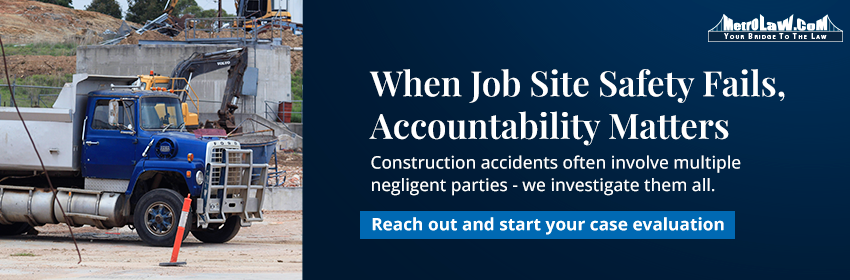
After a construction accident in Elizabeth, your first priority should be your health and safety. Seeking prompt medical care, reporting the injury, and preserving evidence are critical steps that protect both your recovery and your legal rights.
Construction injuries are often severe and may not be fully apparent right away. Falls, head injuries, crush injuries, and electrical shocks can cause internal damage that worsens over time. Seeking immediate medical care protects your health, creates a medical record linking the injury to the accident, and reduces the risk of insurers claiming the injury is unrelated.
Follow all medical recommendations and attend follow-up appointments. Gaps in treatment are often used to challenge injury claims.
Notify your supervisor or employer as soon as possible. Many construction sites have formal incident reporting procedures. Reporting the injury creates an official record, triggers workers’ compensation coverage, and helps establish when and how the accident occurred. Even if your employer discourages reporting or suggests “working through it,” failing to report an injury can seriously harm your claim.
If you are able, take photos or videos of:
Construction sites change quickly. Evidence can disappear as work continues, making early documentation especially important.
Coworkers, subcontractors, or bystanders may have seen the accident. Get names and contact information whenever possible.
Do not assume workers’ compensation is your only option. Many construction accidents involve negligence by third parties, which may give rise to additional claims beyond workers’ comp.
Construction sites involve a unique combination of hazards that make injuries more severe and more likely to cause long-term disability.
Construction workers routinely face:
A single mistake (or a safety failure by someone else) can result in catastrophic injury.
Many construction projects in Elizabeth involve general contractors, subcontractors, equipment suppliers, or property owners. When multiple companies work on the same site, safety responsibilities can become unclear, increasing the risk of accidents.
Elizabeth’s dense layout and proximity to major roads mean construction often happens near active traffic, pedestrians, and existing structures. These conditions increase the likelihood of struck-by accidents, vehicle collisions, and falls.
Construction accidents can happen in many ways, but certain types occur far more frequently and tend to cause serious injuries.
Falls remain one of the leading causes of construction injuries and fatalities. Common fall scenarios include falls from scaffolding, ladder collapses, roof falls, and unprotected edges or openings. Lack of guardrails, improper scaffolding, and inadequate fall protection are frequent contributors.
Workers may be struck by falling tools or materials, moving equipment, and vehicles entering or exiting the site. These accidents often cause head injuries, fractures, and internal trauma.
Workers can become trapped between heavy equipment, collapsing trenches, or moving machinery. These incidents frequently result in crush injuries or fatalities.
Contact with live electrical lines or faulty wiring can cause severe burns, cardiac injuries, or nerve damage. Electrical injuries often have long-term consequences.
Defective or poorly maintained equipment can malfunction, leading to serious injuries. Responsibility may extend beyond the employer to manufacturers or maintenance companies.
Construction accident liability often involves more than just the injured worker’s employer. Identifying all responsible parties is key to pursuing full compensation.
In most cases, injured workers cannot sue their direct employer but are entitled to workers’ compensation benefits. These benefits cover medical care and partial wage replacement but do not include pain and suffering.
General contractors often have overall responsibility for site safety. They may be liable if safety rules were not enforced, hazards were ignored, and coordination failures created dangerous conditions.
Subcontractors may be responsible when their work creates unsafe conditions, equipment is improperly used, or safety standards are violated.
Property owners may share liability when they control the site, fail to correct known hazards, or allow unsafe conditions to persist.
If defective equipment caused the injury, manufacturers or distributors may be liable under product liability laws.
Construction injuries are often severe and life-changing.
These injuries can require lifelong care and significantly affect quality of life.
Some injuries never fully heal, limiting a worker’s ability to return to construction work.
Burns can result in:
Electrical injuries may cause internal damage not immediately visible.
Many construction injuries result in permanent work restrictions or total disability, leaving future employment uncertain.

Most injured construction workers are covered by workers’ compensation, but that does not always end the legal analysis.
Workers’ comp generally provides medical treatment, temporary disability payments, and permanent disability benefits. These benefits apply regardless of fault but are limited.
Workers’ compensation does not cover:
For serious injuries, these limits can leave workers undercompensated.
When someone other than the employer caused or contributed to the accident, a third-party claim may be possible. These claims can provide compensation for:
Large construction sites in Elizabeth often involve multiple parties, making third-party claims common.
Construction accident claims are rarely straightforward. Evidence must be preserved quickly, and safety failures must be identified.
Construction sites are governed by extensive safety regulations. Violations may involve fall protection requirements, equipment standards, or training obligations. Information about workplace safety standards is available through the Occupational Safety and Health Administration.
Understanding how an accident occurred may require reviewing site plans, analyzing equipment, or consulting safety experts.
Construction sites change rapidly. Prompt investigation helps preserve evidence before it is altered or removed.
Construction accident claims require far more than showing that an injury occurred. These cases often involve multiple companies, overlapping safety responsibilities, and aggressive insurance defenses.
MetroLaw.com approaches construction accident cases with detailed investigation and strategic case-building designed to uncover negligence and secure full compensation.
The first step is understanding the conditions that existed at the time of the accident. Construction sites change quickly, so early investigation is critical. This may involve:
In Elizabeth, construction often takes place near active roadways or commercial areas, which can create additional safety risks and involve third parties.
Construction accidents rarely involve only one negligent party. Liability may extend to:
Identifying all responsible parties increases the likelihood of adequate insurance coverage and full recovery.
Construction sites are subject to extensive safety regulations. Our construction accident attorneys review:
Failure to follow required safety standards can be strong evidence of negligence.
Using Experts When Needed
Complex construction accident cases often require expert input. Depending on the circumstances, experts may help analyze fall protection failures, scaffolding or ladder defects, equipment malfunctions, trenching and excavation hazards. Expert analysis can clarify how an accident occurred and why it should have been prevented.
Despite the serious nature of construction injuries, insurance companies and corporate defendants often fight these claims aggressively.
Defendants may argue the injured worker caused the accident, safety equipment was available but not usedm, another contractor was responsible, and the injury was less severe than claimed. These arguments are often designed to shift blame and reduce financial exposure.
Injured workers may be offered quick settlements that fail to account for long-term medical needs, permanent work restrictions, future wage loss, and pain and suffering. Accepting early offers can leave workers without adequate resources later.
Construction accident cases may be slowed by disputes between insurers, incomplete incident reports, or missing safety documentation. Thorough preparation helps counter these obstacles.
Construction accident claims differ significantly from typical workplace injury cases.
Construction accidents are more likely to involve:
As a result, the damage is often much more serious.
Unlike many workplace injuries, construction accidents often involve:
This creates additional legal complexity but also more avenues for recovery.
Third-party construction accident claims may allow recovery for pain and suffering, full wage loss, future earning capacity, and emotional distress. These damages are not available through workers’ compensation alone.
Many construction injuries permanently affect a worker’s ability to perform physical labor.
Injuries may limit lifting capacity, balance or mobility, hand or arm use, or tolerance for prolonged standing. These restrictions can end a construction career.
When a worker cannot return to construction, the impact may include loss of a skilled trade, reduced earning capacity, and a need for retraining or career changes. Claims should account for these long-term consequences, not just immediate wage loss.
Failing to account for future limitations can leave injured workers financially vulnerable for years.

Falls are one of the leading causes of serious injury and death on construction sites.
Even falls from moderate heights can cause devastating injuries.
Contractors are required to provide:
Failure to meet these obligations often forms the basis of liability.
Construction workers rely on machinery and tools that must function safely.
Malfunctions or improper maintenance can cause serious injuries.
When defective equipment causes injury, responsibility may extend to manufacturers, distributors, and maintenance providers. Product liability claims may be pursued alongside other construction accident claims.
Electrical hazards are common on active construction sites.
Electrical injuries can cause severe burns, cardiac damage, and nerve injuries.
Burn injuries often require multiple surgeries, skin grafts, and long-term rehabilitation. Compensation should reflect both immediate and future medical needs.
There is no fixed timeline for construction accident cases. Factors that affect duration include:
Some cases resolve through settlement, while others require litigation.
Rushing a claim can lead to undervaluation, especially when long-term effects are still emerging. Having a lawyer involved from the start can help ensure the outcome reflects the full scope of the loss.
Construction accident claims are subject to strict deadlines. Missing a deadline can permanently bar a claim, regardless of injury severity. Depending on the case, deadlines may apply to:
General information about civil filing deadlines in New Jersey is available through the New Jersey Courts system.
Trenching and excavation work present some of the most dangerous conditions on construction sites. Even experienced workers face serious risks when trenches collapse or excavation areas are not properly secured. These accidents often result in catastrophic injuries or fatalities.
Trenches can collapse without warning, burying workers under thousands of pounds of soil in seconds. These incidents often cause crush injuries, suffocation, traumatic brain injuries, or spinal injuries. Unlike other construction hazards, trench collapses leave little time for escape or rescue.
Trenching accidents frequently involve:
These failures are often preventable and point directly to negligence by contractors or site supervisors.
Liability for trenching accidents may extend to general contractors overseeing site safety, subcontractors performing excavation work, or property owners who approved unsafe work conditions. Because trenching work often involves specialized contractors, third-party claims are common.
Construction sites in Elizabeth are frequently located near active roadways, creating additional hazards for workers.
Workers may be struck by dump trucks, delivery vehicles, forklifts, or backing construction equipment. Poor traffic control, inadequate signage, and a lack of spotters often contribute to these accidents.
Construction near busy streets exposes workers to passing traffic, distracted drivers, and limited visibility. These accidents may involve third-party drivers in addition to construction companies, expanding potential liability.
Traffic-related construction accidents may involve contractors responsible for work zone safety, municipalities or project managers, or negligent drivers entering work zones. Identifying all responsible parties is critical for full compensation.
Many construction injuries do not fully reveal their severity immediately after the accident.
Injuries that may worsen include back and spinal injuries, head injuries, internal injuries, and joint and ligament damage. Workers may initially return to work only to experience increasing pain or disability weeks later.
Construction injuries often require ongoing physical therapy, surgical intervention, pain management, or long-term medical monitoring. Claims must account for these future medical needs, not just initial treatment.
As symptoms worsen, injured workers may lose the ability to perform physical labor, require job restrictions, or face reduced earning capacity. Proper documentation of progression is essential to avoid undervaluing the claim.
Construction accident claims are rarely resolved quickly or easily.
Claims may involve workers’ compensation insurers, general liability insurers, commercial auto insurers, or product liability carriers. Coordination among multiple insurers often causes delays.
Defendants frequently shift blame to other contractors, the injured worker, or site conditions beyond their control. Persistence and thorough documentation are key to overcoming these defenses.
A well-prepared construction accident claim is designed not just to resolve quickly, but to protect the injured worker’s long-term financial stability.
Yes. While you generally cannot sue your employer, you may pursue third-party claims against other responsible parties on the site.
Partial fault does not automatically bar recovery. Liability is often shared among multiple parties.
Yes. Immigration status does not prevent injured workers from pursuing compensation.
You may have a product liability claim against the manufacturer or supplier in addition to other claims.
Case value depends on injury severity, long-term impact, and available insurance coverage.
Many cases resolve through settlement, but some require litigation to achieve fair compensation.
Worsening injuries should be documented immediately, as they can significantly affect compensation.
Deadlines vary depending on claim type. Acting early helps protect your rights.
If you were injured on a construction site in Elizabeth, the steps you take now can shape your recovery and financial future.
MetroLaw.com represents injured construction workers throughout Elizabeth and Union County. We handle workers’ compensation coordination, investigate third-party liability, and pursue full compensation for serious construction injuries.
Call 973-344-6587 or click here for a free consultation and learn how MetroLaw.com can help you move forward after a construction accident.