If you were involved in a car accident in Newark and someone else may be responsible, speaking with a lawyer can help you understand your options. Car accident claims often involve more than vehicle damage, especially when injuries, medical care, or missed work are involved.
Newark’s roads are busy and unpredictable. Crashes happen daily on I-280, Route 21, and near Newark Penn Station, where commuter traffic, delivery vehicles, and local drivers all converge.
In these areas, accidents often involve multiple vehicles, conflicting stories, and insurance pressure right away. What you do in the first days after a crash can affect your ability to recover compensation later.
Car accident cases are not just about what happened at the scene. They also involve medical documentation, insurance rules, and evidence that must be handled carefully.
At MetroLaw.com, we help Newark drivers and passengers make sense of the process and move forward with a clear plan after an unexpected crash.
Car accidents in Newark often unfold quickly due to heavy traffic, frequent intersections, and mixed vehicle use. Many crashes begin with sudden stops, unsafe lane changes, or missed signals, especially in high-volume areas where drivers are navigating congestion, buses, and pedestrians at the same time.
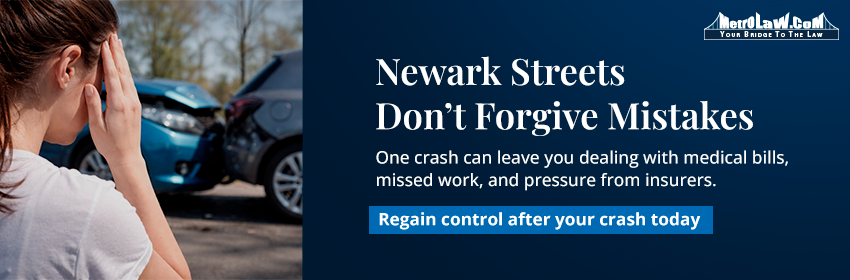
Newark’s road network forces drivers into close quarters. Sudden braking and tight spacing leave little room for error.
These conditions are common:
Rear-end and chain-reaction crashes often start this way.
Intersections are a major flashpoint for accidents. Confusion over right-of-way and aggressive turns frequently leads to side-impact collisions.
High-risk areas include:
According to data published by the New Jersey Department of Transportation, urban areas with dense traffic, frequent intersections, and mixed transportation modes experience higher crash rates than less congested regions.
This helps explain why accidents in cities like Newark often involve multiple factors rather than a single mistake.
What starts as a traffic issue can quickly become a legal matter when injuries occur. Conflicting accounts, limited visibility, and fast-moving traffic often make early evidence and documentation especially important in Newark crashes.
Newark car accidents are legally complex because they often involve heavy traffic, multiple vehicles, and overlapping insurance coverage. Crashes in dense urban areas can raise questions about fault, evidence, and responsibility that are not always clear at the scene.
In busy areas, accidents rarely involve just two vehicles. Different drivers may recall events differently, making fault harder to establish.
This often occurs:
Urban crashes may involve drivers operating company vehicles, rideshare cars, or personal vehicles with different policies.
These situations can include:
Sorting out which policy applies can delay or complicate claims.
Accident scenes in Newark change quickly. Vehicles are moved, traffic resumes, and evidence disappears fast.
This is common near:
They can slow investigations, increase disputes over fault, and make early evidence collection more important for protecting a claim.
In many Newark car accidents, responsibility does not stop with the other driver. Additional parties may be involved when someone else controlled the vehicle, the roadway, or conditions that contributed to the crash.
Some crashes involve drivers who were working at the time of the accident. When that happens, their employer may share responsibility.
This often applies to:
The driver is not always the owner of the vehicle. Problems with maintenance or known defects can shift responsibility.
These situations may involve:
In some cases, the condition of the road plays a role in the crash. Poor design or maintenance can contribute to dangerous driving situations.
This may include:
Chain-reaction accidents can involve several drivers whose actions combine to cause injuries. Identifying each role requires a closer look at timing, traffic flow, and driver behavior.
In Newark’s busy traffic environment, these added layers often make determining responsibility more complex than it first appears.
The most important evidence after a Newark car crash is what clearly shows how the accident happened, who was involved, and how injuries occurred. In busy areas, strong evidence helps cut through conflicting accounts and insurance disputes.
Physical details help reconstruct how the crash unfolded. This evidence often disappears quickly once traffic resumes.
Key examples include:
This is especially important on roads like Route 21 and I-280.
Video evidence can provide an objective view of the accident and often carries significant weight.
Sources may include:
Medical records connect the crash to real physical harm. Consistent treatment helps establish credibility.
Important documentation includes:
Witnesses can help clarify disputed details, especially in multi-vehicle crashes.
Useful sources include:

Evidence should be gathered as soon as possible, ideally within days, before conditions change and essential details are lost.
Delayed symptoms can significantly affect car accident claims because injuries are not always obvious right after a crash.
In Newark, many drivers and passengers feel fine at the scene, only to experience pain or neurological symptoms hours or days later. These delayed injuries are common and do not make a claim less valid, but they do require careful documentation.
Adrenaline often masks pain immediately after a collision. Once it wears off, symptoms can surface.
This frequently happens after crashes on:
Drivers may leave the scene thinking they are unharmed, only to notice stiffness, headaches, or dizziness later.
Some of the most common car accident injuries take time to appear. These injuries can worsen without proper care.
Delayed-onset injuries often include:
These injuries are especially common in rear-end and side-impact crashes, which are frequent in Newark’s stop-and-go traffic.
Insurance companies often question injuries that are not reported immediately. Delayed treatment can be used to argue that the injury was unrelated to the crash.
This makes it essential to:
In Newark car accident cases, medical timelines often play a central role in how claims are evaluated.
Medical records help connect delayed symptoms to the accident. Consistency matters more than speed alone.
Helpful documentation includes:
Even if treatment starts days after a crash, proper records can still support a valid claim.
Delayed injuries often interfere with work, commuting, and daily responsibilities. In Newark, where many people rely on driving or public transportation, injuries can quickly disrupt routines.
These effects may include:
These impacts are part of the overall claim and should be documented.
Taking action when symptoms emerge helps protect both health and legal options.
Important steps include:
Delayed symptoms are common after Newark car accidents. Recognizing them early and responding properly can make a meaningful difference in how a claim is handled and resolved.
Newark car accident claims often differ from suburban crash cases because of traffic density, road design, and the number of people involved. Urban accidents tend to involve more evidence, more disputes, and greater insurance complexity than crashes in less congested areas.
Newark’s roads are rarely quiet. Heavy traffic increases the chance of multi-vehicle collisions and sudden stops.
Urban crash conditions often include:
Suburban crashes are more likely to involve higher speeds but fewer vehicles.
Urban areas offer more potential sources of evidence, but also more challenges.
In Newark, evidence may include:
In suburban areas, evidence is often limited to vehicle damage and driver statements.
Urban crashes tend to trigger more aggressive insurance responses due to higher claim values and liability disputes.
These cases often involve:
The strategy used in a Newark car accident claim often reflects the environment where the crash occurred. Understanding local traffic flow, congestion points, and evidence sources can shape how the claim is handled from start to finish.
We build leverage in Newark car accident cases by locking down evidence early, proving liability clearly, and documenting the full impact of the injuries. When insurers see a case that is organized, well-supported, and ready for litigation if needed, negotiations tend to change fast.

Crash scenes in Newark move quickly. Cars get towed, traffic clears, and drivers start rewriting what happened.
We secure:
This is especially important near I-280 ramps and downtown intersections.
Leverage often comes down to available coverage. Newark crashes frequently involve vehicles tied to work, deliveries, or shared use.
We confirm:
This prevents insurers from pointing fingers and delaying responsibility.
Video evidence can end disputes quickly. Newark has more camera coverage than many suburban areas, but the footage does not stay available forever.
We look for:
Footage near Newark Penn Station or major corridors can be especially valuable.
Medical documentation makes injuries real on paper. Consistent treatment also helps reduce insurer arguments about delayed symptoms or unrelated conditions.
We organize:
Insurers negotiate based on numbers and proof. We present losses in a way that is detailed, concrete, and difficult to dismiss.
This includes:
Leverage increases when the case is trial-ready. If an insurer refuses to deal fairly, the claim is positioned to move forward through the appropriate court process without scrambling for missing evidence.
Newark’s layout, traffic flow, and court environment directly shape how car accident claims are handled. MetroLaw.com tailors claim strategy to the realities of Newark, using local knowledge to gather stronger evidence, anticipate insurer tactics, and position cases for better outcomes.
Knowing where and how accidents happen in Newark helps shape the investigation from day one.
Our attorneys regularly work with cases involving:
This familiarity helps identify contributing factors that outsiders may overlook.
Urban cases rely heavily on fast-moving evidence. MetroLaw.com knows where to look and how to act quickly.
This includes:
Timing matters in Newark, where footage may be overwritten within days.
Handling cases in Newark means understanding how the local system operates. Procedural awareness helps keep cases moving efficiently.
Our experience includes:
Insurance companies adjust their approach based on location and perceived legal pressure. MetroLaw.com’s familiarity with Newark cases helps push back when claims are undervalued or delayed.
Local experience allows us to build credibility, apply pressure, and advocate effectively for injured clients.
After a car accident in Newark, the following steps should focus on protecting your health, preserving evidence, and avoiding decisions that could weaken your claim. What you do in the hours and days following a crash can directly affect your ability to recover compensation.
Medical care comes first, even if injuries seem minor. Some conditions take time to appear and can worsen without treatment.
Be sure to:
This is especially important after crashes on I-280, Route 21, or near Newark Penn Station.
Accurate documentation helps preserve what happened before details are lost.
Helpful steps include:
Insurance companies may contact you quickly. Early statements can affect how a claim is evaluated.
Before responding:
Car accident claims often involve insurance rules, evidence deadlines, and liability questions. Speaking with a lawyer can help you understand the process and take the right steps based on where and how the accident occurred in Newark.
In most cases, New Jersey law allows two years to file a car accident claim, but certain situations may shorten that deadline depending on the parties involved.
Yes. New Jersey follows comparative negligence rules, which may allow recovery even if you share some responsibility for the accident.
You may still have options through your own uninsured motorist coverage, depending on your auto insurance policy.
Yes. Some injuries do not show symptoms immediately, and medical records help document any delayed conditions tied to the crash.
Yes. Passengers may file claims against the at-fault driver or drivers involved in the crash.
Crashes involving work vehicles may trigger commercial insurance coverage, which can affect liability and compensation options.
Police reports are not always required, but they often help document the crash and support the claim.
Timelines vary based on injuries, insurance disputes, and evidence, but many cases take several months or longer to resolve.
Yes. Delayed symptoms are common, and claims can still be valid when medical records support the injury timeline.
Early settlement offers often undervalue claims. It’s important to understand the full impact of injuries before agreeing to any offer.
At MetroLaw.com, we are dedicated to providing comprehensive guidance for all your legal needs. We encourage you to visit our FAQ section to explore more frequently asked questions about various types of claims and lawsuits in New Jersey. Your understanding is our priority, and we are here to help you navigate through the complexities of the legal system.
Car accidents in Newark can leave people dealing with injuries, insurance pressure, and uncertainty about what comes next. Between congested roadways, busy intersections, and mixed traffic patterns, crashes in the city often involve more than a simple exchange of information.
Understanding how car accident claims work, what evidence matters, and how delayed injuries affect recovery can help protect your rights.
Each accident is different. Some involve multiple vehicles, others hinge on insurance coverage, and many require careful documentation to establish fault. Location plays a key role in how claims are investigated, from access to video footage to identifying witnesses and responsible parties.
Taking early, informed steps can help preserve important details and avoid common mistakes.
Car accident claims are not just about repairing a vehicle. They often involve medical care, time away from work, and long-term effects that are not immediately visible. Knowing how insurance rules apply and when legal options may be available can make the process easier to navigate.
If you were injured in a car accident in Newark and need guidance about your next steps, our team at MetroLaw.com is available to help you understand your options and move forward with confidence.