
Hiring a slip and fall lawyer in Newark is important because these cases are rarely as simple as they seem, and property owners often deny responsibility from the start. An experienced attorney can investigate unsafe conditions, preserve evidence, and handle insurers while you focus on recovering from your injuries.
Slip and fall accidents occur every day across Newark in places that people expect to be safe, including grocery stores, apartment buildings, parking garages, and sidewalks near Broad Street, Market Street, and downtown commercial areas.
Hazards such as wet floors, broken pavement, poor lighting, and delayed maintenance can turn routine errands into serious injury situations.
At MetroLaw.com, we represent individuals who have been injured in slip and fall accidents throughout Newark, from residential neighborhoods to busy retail corridors. We understand how premises liability claims work under New Jersey law and what it takes to prove that a property owner failed to address or warn about a dangerous condition.
When a fall disrupts your health, work, and daily routine, having a legal team that knows Newark and knows how these cases are built can make a meaningful difference.
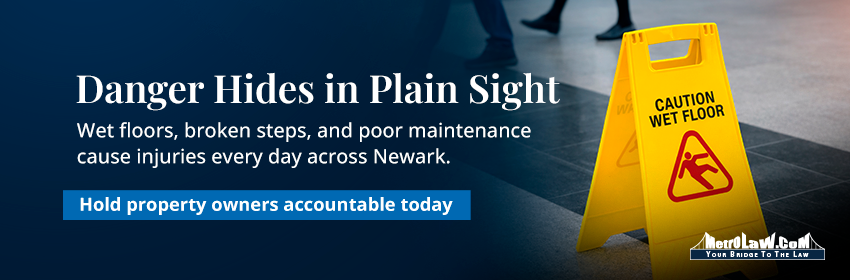
Slip and fall accidents in Newark are caused by hazards that make walkways unsafe, such as wet floors, uneven pavement, or poor lighting, and these dangers are common in stores, sidewalks, and building entryways throughout the city.
According to the CDC, falls are one of the most frequent causes of injury requiring medical attention, and about 37% of falls result in injury serious enough to restrict activity or need treatment.
These kinds of accidents can happen anywhere pedestrians encounter unsafe surfaces, from grocery aisles near Market Street to cracked sidewalks in older residential blocks.
Slippery floors in supermarkets, spills in lobbies, and loose carpeting in Newark apartment buildings create fall risks that property owners must address.
Dark hallways, stairwells, or cluttered entry points reduce visibility and increase the chance someone loses their footing, especially after sunset.
Busy corridors near Broad Street and downtown retail districts see fast flows of people, where small hazards can quickly turn into serious accidents.
Slip and fall accidents in Newark most often happen in places with heavy foot traffic and inconsistent maintenance, where hazards go unnoticed or unaddressed. These locations include commercial properties, residential buildings, and public walkways used daily by residents and visitors.
Falls frequently occur in grocery stores, pharmacies, and retail spaces along Broad Street, Market Street, and downtown shopping areas. Spills, wet entryways, and poorly maintained floors are common risks in these environments.
High customer volume increases the likelihood of spills and slick floors, especially near refrigerated sections, entrances, and checkout aisles.
Common areas such as lobbies, stairwells, and shared hallways often become dangerous when lighting is poor or surfaces are uneven.
Cracked pavement, raised slabs, and icy conditions create fall hazards on sidewalks throughout Newark neighborhoods, particularly in older residential areas.
Oil residue, poor drainage, and uneven surfaces increase the risk of slipping in garages and surface lots near commercial buildings.
The location of a slip and fall incident affects legal responsibility by determining who controls the property and its maintenance. For example, property owners may be liable for unsafe conditions on private property, while government entities might have limited liability in public areas. Thus, the location is crucial in establishing who is responsible.
Slip and fall accidents in Newark often cause injuries that affect mobility, balance, and long-term physical comfort. A sudden fall on a hard surface can place intense force on the body, leading to injuries that may not be immediately obvious.
These accidents frequently happen in grocery stores, apartment buildings, parking garages, and on sidewalks near Broad Street, Market Street, and residential neighborhoods where surfaces are uneven or poorly maintained.
Falls can cause concussions or more serious head trauma when a person strikes the floor or surrounding objects. These injuries may lead to headaches, dizziness, or cognitive changes that require ongoing care.
A fall often twists or compresses the spine, resulting in herniated discs, nerve damage, or chronic pain. Injuries like these are common in stairwell and parking garage falls.
Broken wrists, arms, ankles, and hips frequently occur as people instinctively try to brace themselves during a fall. Recovery can involve surgery and physical therapy.
Muscle tears, ligament damage, and internal bruising can develop even when there are no visible signs of injury at first. Prompt medical evaluation is essential after a fall.
Slip and fall injuries can disrupt daily routines and require extended treatment, making proper documentation and care critical.
Responsibility for a slip and fall injury in Newark usually falls on the party that owned, controlled, or maintained the property where the accident happened. Liability depends on whether that party failed to fix a dangerous condition or warn people about it within a reasonable time.
Slip and fall accidents often occur in places like grocery stores along Market Street, apartment buildings in the Ironbound, parking garages downtown, and sidewalks in residential neighborhoods. Each location carries different maintenance obligations.
Owners and property managers are responsible for keeping walkways, entrances, and common areas reasonably safe. This includes routine inspections and timely repairs.
Common failures include:
Retail stores, restaurants, and other businesses may be responsible when a hazard forms during daily operations. This often applies to supermarkets, pharmacies, and shops with constant foot traffic.
Some falls happen on sidewalks, public buildings, or government-owned property. Claims involving public entities follow special notice rules and shorter deadlines.
How Is Responsibility Determined When Multiple Parties Control The Property?
Responsibility is determined by examining which parties had control over the property and who was responsible for its maintenance at the time of the incident. This requires a thorough review of leases, contracts, and property records to clarify liability among the involved parties.

Premises liability law applies to slip and fall cases by requiring property owners and occupiers to keep their premises reasonably safe for visitors. When a hazardous condition causes a fall, and the responsible party failed to repair it or provide a warning, liability may arise under New Jersey law.
In Newark, these cases commonly involve retail stores, apartment buildings, parking facilities, and sidewalks near busy areas like Broad Street, Market Street, and downtown commercial zones. The law looks closely at control, notice, and reasonableness.
The level of responsibility depends on why the person was on the property, such as shopping, visiting, or living there. Property owners owe the highest duty of care to customers and tenants.
Liability often turns on whether the owner knew or should have known about the dangerous condition. Long-standing hazards, recurring issues, or ignored complaints strengthen a claim.
When property owners do not repair unsafe conditions or post clear warnings, they may be held responsible for resulting injuries. Warning signs alone may not be enough if the danger remains unaddressed.
Premises liability cases focus on whether reasonable steps were taken to prevent foreseeable harm.
The most important evidence in a slip and fall claim is proof that a dangerous condition existed and that the responsible party failed to address it in time.
Strong evidence shows how the hazard formed, how long it was present, and how it directly caused the fall and resulting injuries.
In Newark, slip and fall accidents often happen in grocery stores, apartment buildings, parking garages, and on sidewalks near Broad Street, Market Street, and downtown business districts. Evidence from these locations can disappear quickly if it is not preserved early.
Photos and videos taken close to the time of the fall can capture conditions that later change or are repaired. These visuals help establish what the property looked like when the accident occurred.
Useful images often include:
Many businesses and property managers create internal reports after a fall. These records may document the hazard, employee responses, or prior complaints.
Maintenance and cleaning logs can reveal:
People who saw the fall or noticed the hazard beforehand can provide critical context. Witness accounts help confirm how long the condition existed and how the accident unfolded.
This is especially important in busy Newark locations where foot traffic is constant, and conditions change quickly.
Medical records help connect the fall to specific injuries and establish their severity. Emergency room notes, follow-up visits, and treatment plans all play a role.
Clear documentation strengthens the claim by showing the full impact of the accident on health and mobility.
Strong slip and fall cases are built on clear, consistent evidence that ties the hazard to the injury without gaps or speculation.
Slip and fall claims differ from trip and fall claims based on how the accident happens, what causes the loss of balance, and how liability is proven under New Jersey law. While both fall under premises liability, the type of hazard involved changes the evidence required and the arguments used to establish responsibility.
In Newark, these distinctions matter because falls happen in a wide range of settings, from grocery stores along Market Street to apartment buildings in the Ironbound and sidewalks near Broad Street and downtown offices. Identifying whether a person slipped or tripped helps define what went wrong and who failed to fix it.
Slip and fall accidents usually involve a loss of traction between footwear and the walking surface. These cases often center on substances or conditions that make floors slick or unstable.
Common slip hazards include:
In Newark retail stores and building lobbies, these hazards are often temporary but dangerous when not addressed promptly.
Trip and fall accidents happen when a person’s foot catches on an object or uneven surface, causing them to stumble forward. These cases focus more on structural or layout issues.
Typical trip hazards include:
Trip hazards are frequently found on older sidewalks, in parking garages, and inside apartment buildings throughout Newark neighborhoods.
Slip cases often rely on proving how long a liquid or slick condition was present and whether staff inspected the area. Trip cases focus more on measurements, photographs, and proof that the defect existed long enough to require repair.
Video footage, maintenance logs, and prior complaints play different roles depending on the type of fall.
Slip and fall accidents often result in backward falls, increasing the risk of head, neck, and spinal injuries. Trip and fall accidents more commonly cause forward falls, leading to wrist, knee, and facial injuries.
These injury patterns can help clarify how the accident happened.
While both claims require showing negligence, slip cases often emphasize cleaning procedures and response time, while trip cases focus on property condition and long-term neglect.
Understanding the distinction helps ensure the claim is framed accurately and supported with the right evidence, especially in complex Newark premises liability cases.

We prove a slip and fall case by showing three things clearly: a dangerous condition existed, the responsible party had enough time or reason to address it, and that hazard caused real injuries with measurable impact. In Newark, that proof often comes from fast evidence capture and a disciplined investigation.
Falls in places like Market Street retail corridors, downtown parking garages, or apartment common areas in the Ironbound can become “their word versus yours” if the scene changes. Our process is built to prevent that.
We identify who owned, managed, or maintained the specific area where you fell. That can include property owners, management companies, commercial tenants, or contractors.
We confirm:
We move quickly to document what caused the fall, especially when staff cleans up spills or repairs defects soon after an incident.
We focus on:
Video footage can show how the hazard formed and how long it was present. Internal incident reports and maintenance logs often reveal what the property knew and when.
Key records include:
Many Newark slip and fall cases turn on notice, meaning whether the property had enough time to fix the problem or warn people. We reconstruct the timeline using footage, employee statements, and building documentation.
This step helps show:
We organize medical records to show that the injuries came from the fall and explain how they affect work and daily function. Clear documentation often makes the difference between a low offer and a serious evaluation.
We gather:
We prepare a claim package that tells a clear story, backed by records, visuals, and timelines. If the insurer refuses to be reasonable, we maintain the case posture needed for litigation in New Jersey courts. That approach keeps the focus on accountability, not excuses.
Yes, a missing warning sign can strengthen a claim, but liability depends on whether the property owner knew or should have known about the hazard and failed to fix or warn about it within a reasonable time.
Property owners often make this argument, but maintenance records, video footage, and witness statements can help show that the condition existed long enough that it should have been addressed.
Yes, it does matter where you fell. Indoor falls typically relate to private property rules, while falls on the sidewalk could involve municipal responsibility or nearby property owners, depending on local responsibilities and maintenance laws in Newark and New Jersey.
Possibly. Partial distraction does not automatically bar recovery, and compensation may still be available depending on how dangerous the condition was and whether the property owner failed to correct it.
Weather alone does not excuse unsafe conditions. Property owners are expected to take reasonable steps to address tracked-in water, ice, or snow, especially in entrances and high-traffic areas.
Retail stores open to the public are expected to inspect and maintain their floors regularly, especially in areas prone to spills, making them more accountable for hazards that go unnoticed.
Yes, surveillance footage can significantly influence a slip and fall claim. It provides visual evidence that can illustrate how long a hazard was present and whether employees ignored it. The specifics of how the fall occurred make it one of the most compelling forms of evidence in such cases.
Delayed reporting can complicate a claim, but it does not automatically prevent recovery if medical records, witness accounts, and other evidence still connect the injury to the fall.
Timelines vary based on injury severity, evidence strength, and insurance response, but many cases take several months, especially when ongoing medical treatment is involved.
The responsibility for maintenance can vary among owners, management companies, tenants, or contractors, based on who had control of the area and was designated for maintenance duties at the relevant time.
Construction zones introduce additional safety duties, and liability may extend to contractors or property managers if temporary hazards are not properly secured or marked.
Yes, early statements can be utilized to minimize or deny a claim. Seeking legal guidance can be crucial to ensure that your account is accurate, complete, and not misinterpreted.
Visit our FAQ section if you want to access different frequently asked questions regarding lawsuits and claims in New Jersey.
Slip and fall accidents can disrupt daily routines, create unexpected medical needs, and raise questions about responsibility and recovery. In a city like Newark, where properties range from busy retail spaces to residential buildings and public walkways, understanding how these cases work can help injured individuals make informed decisions.
Each situation is different, and outcomes often depend on evidence, timing, and how the property was maintained. Having clarity about your options can make the process less overwhelming.
To discover more about the legal team at MetroLaw.com and how they advocate for clients throughout Newark and New Jersey, we invite you to explore our About Us section for detailed insights. Your journey to understanding our dedicated approach starts here.